Pages

Friday, 15 February 2013

What Is ISP?


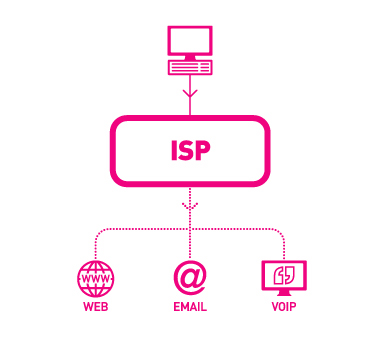
An Internet Service Provider (also known as an ISP or even as an IAP, internet access provider) is a firm that offers subscribers access to the internet. This internet service provider maintains large runs of cabling and maintains network services in order to transfer and deliver web content to those paying the subscription fee. Typically, these internet service providers focus on DSL, Cable modem, wireless, and more recently, dedicated high-speed interconnects such as T1 or fiber optic service (typically abbreviated Fios). While far less common, ISPs still offer dial up internet service, which is gradually become a phased out. All in all, there are many different types of Internet Service Providers, and within each and every internet service provider there are often varying levels of service, coverage, as well as personal customer service that comes attached with it. An Internet Service Provider is a complete package of services, which should be researched and considered before an Internet Service Provider is selected.

For most users, the most important qualification (beyond the ever present price point) is the speed of the connection. Depending on the intended use, there are a myriad of different internet services, and even varying levels of coverage within each and every service. The slowest of these is dial-up internet service. Modern dial-up transfers web content at a maximum rate of 56.6 kilobits per second. In the early days of internet service, this was typically sufficient, as websites were designed with a lean mentality, with very little imagery and a heavy emphasis on text, and text based linking. As time has progressed however, most websites assume that the user is on a high speed connection, and have therefore loaded their website with visual flair and high file size images. What was once acceptable no longer is for most web users, who opt to selecting a faster service.

Mid-Range services available for home include Cable Internet or Digital Subscriber Line (DSL) service. While DSL is available as slow as 128 Kilobits per second (just slightly more than twice the speed of dial-up service) most of these providers have since upgraded their capacity and provide service as fast as 3000 Kilobits per second. For most people, this is sufficient however there are currently faster services available to those who either desire them, or require them to operate their business.

For those simply not interested in paying for internet access, there are a very small number of Free ISPs available. These providers provide internet service free of charge, typically funded through advertising revenue (much like television broadcasts on most stations). Unfortunately, this variety of ISP is gradually falling by the wayside. Netzero, one the earliest example of this service no longer provides an ad supported internet service, and instead focuses on low priced services such as dial up.

All in all, an Internet Service Provider has the very complicated job of setting up and maintaining a network to connect its users to the internet. The inner workings of an ISP vary significantly from company to company, and much of their inner workings are company secret. It's difficult to understand just how internet service providers operate, however from the buyer's perspective the process of using an ISP are incredibly simple. Once a level of connectivity is decided upon, it's simply up to the buyer to research their alternatives, and determine the best solution for their budget and needs.


What Is The Internet?


The Internet (or internet) is a global system of interconnected computer networks that use the standard Internet protocol suite (TCP/IP) to serve billions of users worldwide. It is a network of networks that consists of millions of private, public, academic, business, and government networks, of local to global scope, that are linked by a broad array of electronic, wireless and optical networking technologies. The Internet carries an extensive range of information resources and services, such as the inter-linked hypertext documents of the World Wide Web (WWW) and the infrastructure to support email.

Most traditional communications media including telephone, music, film, and television are being reshaped or redefined by the Internet, giving birth to new services such as Voice over Internet Protocol (VoIP) and Internet Protocol Television (IPTV). Newspaper, book and other print publishing are adapting to Web site technology, or are reshaped into blogging and web feeds. The Internet has enabled and accelerated new forms of human interactions through instant messaging, Internet forums, and social networking. Online shopping has boomed both for major retail outlets and small artisans and traders. Business-to-business and financial services on the Internet affect supply chains across entire industries.

Internet is a short form of the technical term internetwork,  the result of interconnecting computer networks with special gateways or routers. Historically the word has been used, uncapitalized, as a verb and adjective since 1883 to refer to interconnected motions. It was also used from 1974 before the Internet, uncapitalized, as a verb meaning to connect together, especially for networks.  The Internet is also often referred to as the Net.
The Internet, referring to the specific entire global system of IP networks, is a proper noun and written with an initial capital letter. In the media and common use it is often not capitalized, viz. the internet. Some guides specify that the word should be capitalized as a noun but not capitalized as an adjective.


How Does The Connection Work From Home


  • Modems and routers
  • Negotiating a connection


To connect from home you need several things. Apart from a computer, you'll need a phone connection, a modem or ADSL router, and some Internet software. Things will be easier if you're using a relatively recent operation system, such as Windows Vista/XP or MacOSX, but it's possible to connect with older or more obscure systems.

With a modem and the appropriate software, you can dial up another modem connected to another computer, and establish a network connection with it. Usually, this computer is linked into the Internet, and so you're online.

With an ADSL modem or router, a similar procedure happens, but a filter splits the telephone line  into-voice and data (low and high frequencies) and your router negotiates a connection with the ADSL  equipment in the telephone exchange.


How Does Information Travel through The Internet


The Internet is based on packet-switched protocols. Information is carried in packets, which can be imagined as small parcels being passed from computer to computer. Large chunks of data are usually broken up into several smaller packets before being sent through the network. The delivery mechanism or protocol, that is used to encode the packet ensures safe transit, and provides a way of reconstructing the data when it reaches its destination. The protocols used on the Internet are referred to as TCP/IP, standing for Transmission Control Protocol / Internet Protocol.

As a switched network, the physical connections between computers do not matter as far as Internet traffic is concerned — the protocols ensure that guaranteed information delivery is more important than speed or use of a particular route. This means that a sequence of packets might arrive out of order, with some traveling through the net by a faster, shorter route than others. TCP/IP provides the means for your software to piece together those packets into meaningful data. The ability to take different routes through the network is a fundamental part of the original design of TCP/IP, as it allows the Internet to route around damaged areas of the network. 


  • Data is divided up into packets
  • Data routes across the Internet can be switched to avoid congestion
  • Entire mechanism is handled by the TCP/IP  protocols

  • This diagram could make you understand better..!

    TCP/ IP

    TCP/IP (Transmission Control Protocol/Internet Protocol) is the basic communication language or protocol of the Internet. It can also be used as a communications protocol in a private network (either an intranet or an extranet). When you are set up with direct access to the Internet, your computer is provided with a copy of the TCP/IP program just as every other computer that you may send messages to or get information from also has a copy of TCP/IP.

    TCP/IP is a two-layer program. The higher layer, Transmission Control Protocol, manages the assembling of a message or file into smaller packets that are transmitted over the Internet and received by a TCP layer that reassembles the packets into the original message. The lower layer,Internet Protocol, handles the address part of each packet so that it gets to the right destination. Each gateway computer on the network checks this address to see where to forward the message. Even though some packets from the same message are routed differently than others, they'll be reassembled at the destination.

    TCP/IP uses the client/server model of communication in which a computer user (a client) requests and is provided a service (such as sending a Web page) by another computer (a server) in the network. TCP/IP communication is primarily point-to-point, meaning each communication is from one point (or host computer) in the network to another point or host computer. TCP/IP and the higher-level applications that use it are collectively said to be "stateless" because each client request is considered a new request unrelated to any previous one (unlike ordinary phone conversations that require a dedicated connection for the call duration). Being stateless frees network paths so that everyone can use them continuously. (Note that the TCP layer itself is not stateless as far as any one message is concerned. Its connection remains in place until all packets in a message have been received.)

    Many Internet users are familiar with the even higher layer application protocols that use TCP/IP to get to the Internet. These include the World Wide Web's Hypertext Transfer Protocol (HTTP), the File Transfer Protocol (FTP), Telnet (Telnet) which lets you logon to remote computers, and the Simple Mail Transfer Protocol (SMTP). These and other protocols are often packaged together with TCP/IP as a "suite."
    Personal computer users with an analog phone modem connection to the Internet usually get to the Internet through the Serial Line Internet Protocol (SLIP) or the Point-to-Point Protocol (PPP). These protocols encapsulate the IP packets so that they can be sent over the dial-up phone connection to an access provider's modem. 

    Protocols related to TCP/IP include the User Datagram Protocol (UDP), which is used instead of TCP for special purposes. Other protocols are used by network host computers for exchanging router information. These include the Internet Control Message Protocol (ICMP), the Interior Gateway Protocol (IGP), the Exterior Gateway Protocol (EGP), and the Border Gateway Protocol (BGP).